Coffee, Scrubs, and Rubber Gloves
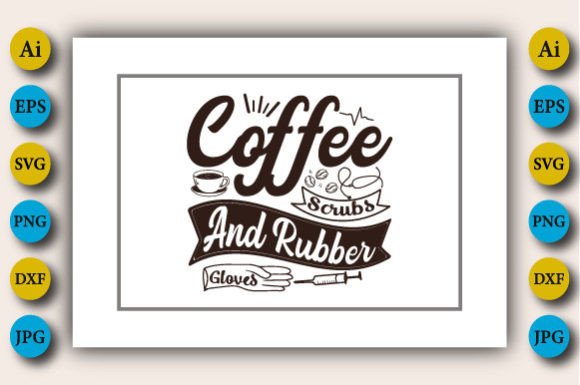
As someone who’s stitched hundreds of designs across apparel, home goods, and boutique merchandise—from nurse-themed aprons for hospital gift shops to custom baby onesies for Etsy sellers—I opened Coffee, Scrubs, and Rubber Gloves expecting a playful, profession-rooted motif. What I found was a tightly composed, conceptually grounded design that lands somewhere between warm humor and quiet respect for frontline work. It’s not just another coffee cup graphic—it’s a visual shorthand for care, routine, and resilience.
I tested it first on a heavyweight cotton twill tote bag destined for a local clinic’s staff appreciation day. The layout—coffee cup centered, “Scrubs” arched above, “Rubber Gloves” curving below—creates natural balance without crowding. There’s no excessive ornamentation: clean outlines, moderate line weight, and open negative space make it forgiving for embroidery interpretation. That matters. Too many “cute” coffee SVGs collapse under satin stitch or bleed on textured fabric. This one breathes.
The mood is grounded, not saccharine. It reads as handmade but polished—ideal for small shop merchandise where customers expect authenticity *and* craftsmanship. Think embroidered sweatshirts for nursing students, tea towels for healthcare-themed kitchen sets, or patches sewn onto lab coats. It also works beautifully on baby caps (with scaled-down lettering) or pillow covers for nursery decor—soft enough for gifting, strong enough to signal identity.
Where Coffee, Scrubs, and Rubber Gloves shines is in its adaptability across real-world embroidery projects. On midweight fleece sweatshirts? Clear, legible, and dimensional with standard fill and satin stitches. On linen tea towels? Crisp edges hold up even with lighter stabilizer. As an embroidered patch? The shape nests cleanly into a 4x4 hoop, and the text sizing avoids micro-detail pitfalls—no tiny serifs or fragile connectors that vanish after washing.
But let’s be practical: this isn’t a one-size-fits-all embroidery file. On stretchy jersey tees, you’ll want cutaway stabilizer—not tear-away—to prevent puckering around the cup’s curved rim. On dark fabrics, test thread contrast early: light tan or heather gray thread reads warmer and more professional than stark white. And if you’re stitching on curved surfaces like structured caps, consider simplifying the bottom “Rubber Gloves” curve slightly—tight arcs can distort at the crown unless your machine handles dense satin stitch well.
I also ran it through a few commercial-use checks. As a digital embroidery file, it holds up in printable mockups—clean vectors translate smoothly to PNG previews for Etsy listings or Instagram product carousels. For craft business owners building cohesive branding, it pairs naturally with neutral palettes and minimalist packaging. Customers recognize the theme instantly, which builds trust: they know what they’re buying before they click “add to cart.” That’s rare in crowded digital marketplaces.
That said, avoid using Coffee, Scrubs, and Rubber Gloves on ultra-thin baby muslin without backing reinforcement—the fine lines in the cup handle and glove fingers may shift. Likewise, skip dense decorative accents (like heavy metallic thread overlays) unless you’ve tested them first; the design’s strength is its clarity, not embellishment. And if you’re planning holiday embroidery—say, for nurse-themed Christmas stockings—confirm the file includes clean stitch paths for tight corners near hems or seams.
Here’s what I do every time I evaluate a new machine embroidery design like this one:
- Run a test stitch on scrap fabric matching my final project’s weight and texture
- Check thread color contrast on both light and dark backgrounds using grayscale mockups
- Review stitch density visually—no muddy fills, no skipped jumps between elements
- Confirm hoop size compatibility (especially for caps or small accessories)
- Inspect small details at 200% zoom: are glove fingers distinct? Does “Scrubs” stay legible at 3 inches wide?
- Test it in black-and-white mode—strong silhouettes mean better recognition at a glance
- Use proper stabilizer for the fabric type (cutaway for knits, tear-away for stable wovens)
- Verify licensing terms before selling finished products or bundling the file commercially
For Etsy sellers and handmade shop owners, Coffee, Scrubs, and Rubber Gloves offers something valuable: built-in storytelling. It doesn’t need explanation. A customer sees it and thinks, “Yes—that’s *my* rhythm.” That emotional resonance lifts perceived value. A $28 embroidered tote feels intentional, not generic. A $42 personalized sweatshirt becomes a keepsake, not just apparel. That’s how design assets become brand assets.
It’s also smart for seasonal or niche launches. Pair it with a “Nurse Appreciation Week” collection, bundle it with coordinating scrub cap patterns, or use it as the anchor for a printable mockup pack targeting healthcare creatives. As a graphics asset, it bridges Crafts and commercial-ready utility—clean enough for vector scaling, expressive enough for heartfelt gifting.
One final note: while the listing mentions “Coffee SVG t-shirt design” and “cut files,” remember this is fundamentally a machine embroidery design in practice. SVGs are great for cutting, but embroidery demands different considerations—stitch order, underlay, pull compensation. If you’re converting it yourself, don’t skip digitizing review steps. Better yet: ask the seller whether a pre-digitized embroidery file is included—or if they offer digitizing support. Clarity there saves hours.
In short, Coffee, Scrubs, and Rubber Gloves earns its place in a working designer’s library—not because it’s trendy, but because it’s thoughtful, resilient, and rooted in real use. It’s the kind of embroidery file you reach for when you need reliability *and* warmth, precision *and* personality. Whether you’re stitching for a client, a craft fair booth, or your own small shop’s next bestseller—it delivers.